
Sachi Shiono Pauses Writing Career After Controversy Over Welfare Benefits and Royalties
Sachi Shiono announced a pause in their writing career after publicly questioning Japan’s social welfare rules. The reason for the frustration? According to Shiono, the royalties earned from their work are treated as property income, meaning the amount of welfare assistance they receive is reduced as they earn money from their novels.
The statement quickly went viral on Japanese social media and sparked a major discussion about work, social welfare, and copyright income. Some people interpreted the complaint as a request to receive both welfare and royalties without deductions, while others saw it as a legitimate criticism of how writers’ income is treated under the system.
The case drew even more attention because Shiono isn’t simply an independent writer: they managed to break into the commercial publishing industry after winning a literary award.
Why Did Sachi Shiono’s Royalties Become So Controversial?
Sachi Shiono is the author of Nagetara Sasatta ~Lucky Hit de Ryoushu ni Natta Boku no Nariagari Eiyuutan~, a work that received the Silver Award at the 6th Shueisha Web Novel Award.
The story is a fantasy comedy following an ordinary young man who, in the middle of a confrontation, casually throws an object and accidentally lands a decisive hit on a target through sheer luck. The seemingly impossible feat causes others to mistake him for a formidable warrior, eventually leading to his surprise appointment as the lord of a territory.
Now forced to manage his lands while surrounded by companions and nobles with sky-high expectations, he has to keep up the act of being a legendary hero while consolidating his power and adjusting to his new life as a ruler.
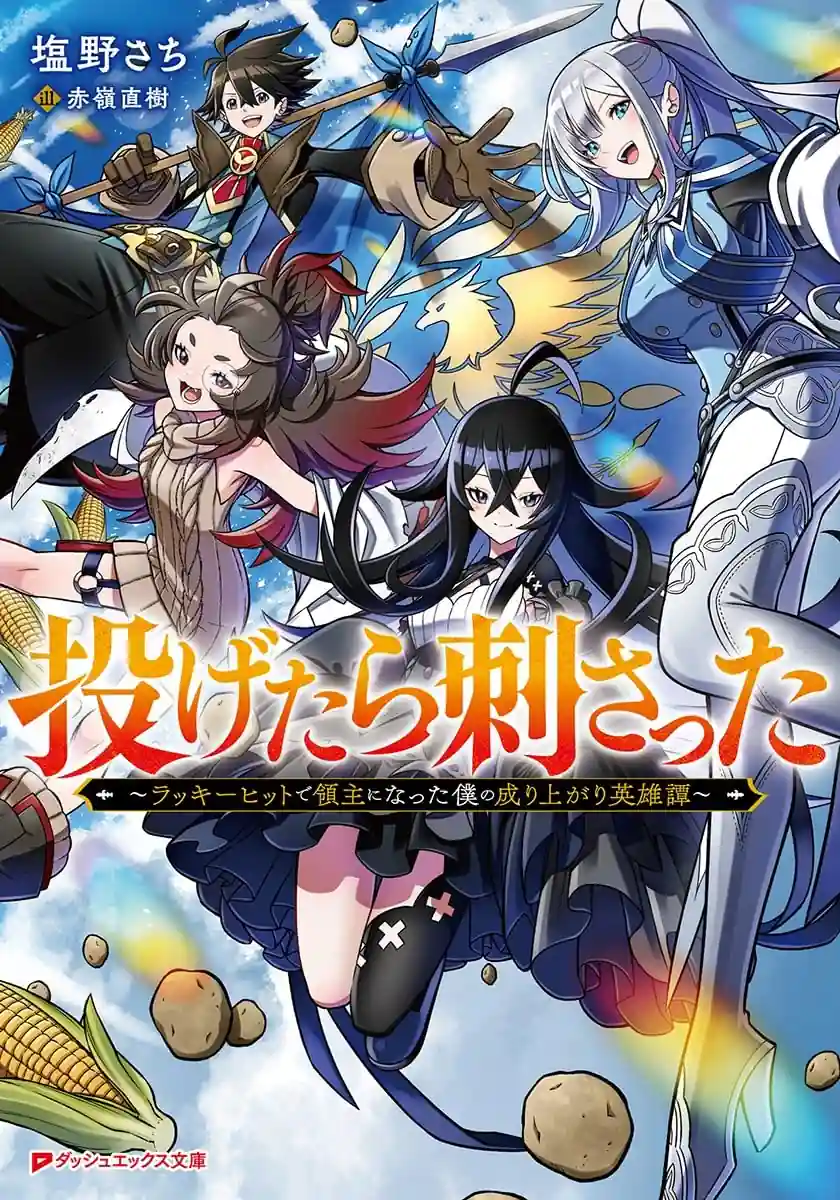
The light novel was commercially published by Dash X Bunko on August 21, 2026, turning the project that began as a web novel into an official commercial publication.
The problem arose because the author receives social welfare, and according to their own explanation, the royalties from their books are treated differently from income earned through conventional employment.
In their post on X, Shiono argued that:
- the money earned from their light novels is classified as property income;
- this type of income does not receive the same treatment as employment income;
- consequently, when royalties are paid, the amount of welfare assistance they receive is reduced;
- in practice, they say they do not see a proportional improvement in their financial situation.
This difference is precisely what led Shiono to question whether authors receiving social welfare should have some form of deduction related to creative work, similar to the mechanism applied to certain types of employment income.
How Does the Social Welfare System Work?
The discussion gets complicated because there is a reason social welfare benefits are recalculated when a recipient starts earning income.
The basic idea is to ensure that citizens have enough resources to maintain a minimum standard of living, supplementing their income when it isn’t enough to reach that level.
Because of this, if someone starts receiving money regularly, their benefits can be reduced. Otherwise, someone with a significant independent income could end up receiving exactly the same benefit as someone with no income at all.
There is, however, an important difference when it comes to writers.
An employee receives a salary as a direct result of their work. A writer, on the other hand, may spend months or even years working on a book and only receive royalties later, once the book is published and sold.
This creates very different situations.
A writer can work today, receive little or nothing for months, and only start receiving payments related to that work later. On top of that, royalties can continue coming in even when the writer is no longer actively working on the project.
That is precisely what makes it difficult to simply apply the same rules used for conventional employment to the publishing industry.
“It’s Like Having All the Money From My Work Taken Away,” Sachi Said
In their statement, Shiono said they had invested an enormous amount of time and effort before finally winning the award and getting professionally published.
For Shiono, writing wasn’t simply a hobby but also a form of work, and they compared the situation to desperately working to earn money only to have all of it taken away afterward, saying that the situation ultimately made them lose their motivation.
After the backlash, the post ended up triggering a major controversy on Japanese social media.
Many users interpreted the statement as Shiono arguing that they should be allowed to receive social welfare without their royalties being taken into account, while others pointed out that the original complaint was more specific: it questioned the lack of a mechanism similar to the deduction applied to certain types of employment income.
The Debate Over Writers Is More Complicated Than It Seems
There is a reasonable argument on both sides.
On one hand, it would be understandable to discuss some form of special treatment for income earned directly through recent creative work. After all, a writer who spends months producing a work and finally manages to publish it is performing professional labor.
On the other hand, royalties don’t work exactly like a salary.
Imagine someone who wrote a book ten years ago and continues receiving royalties every month. They might not currently be working on the book at all, yet they would still be receiving money because they own the copyright.
There is also the possibility of someone receiving inherited copyrights. In that case, the money they receive would have no direct connection to work performed by the beneficiary.
That is where the issue of fairness and balance within the system comes in.
Creating an overly broad deduction could result in people receiving significant additional income while continuing to receive the full benefit. On the other hand, providing no consideration for the effort required to create a new work could discourage precisely the kind of attempt to escape financial hardship through work that the system should ideally encourage.
After the massive reaction to the statement, Sachi Shiono deleted the post they had made on X.
The episode ultimately turned into a much broader discussion: it raised questions about how social welfare systems should handle creative professionals whose income is irregular, particularly in fields such as literature, music, illustration, and independent production.
via Yahoo News