Japan’s Manga Censorship War: Otaku Fight Back Against BL!
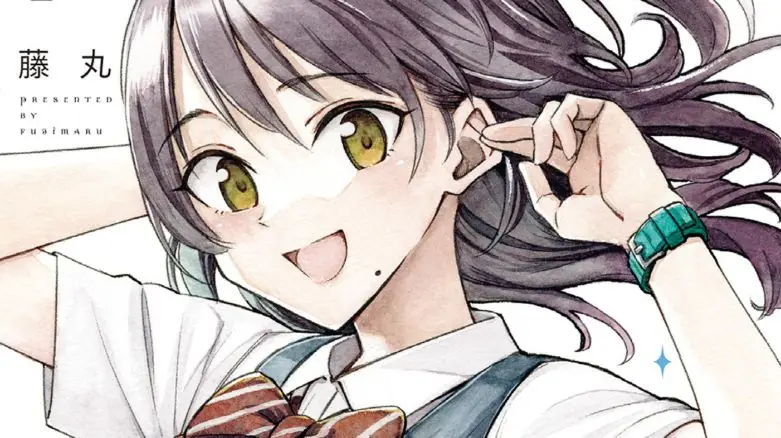
Did you know there’s a full-blown war going on in Japan right now? On one side, you have otaku who just wanted to enjoy their manga in peace, without bothering anyone, without any drama or anything. On the other side, you have women who seem to enjoy bothering people, stirring up trouble, and finding problems with absolutely everything.
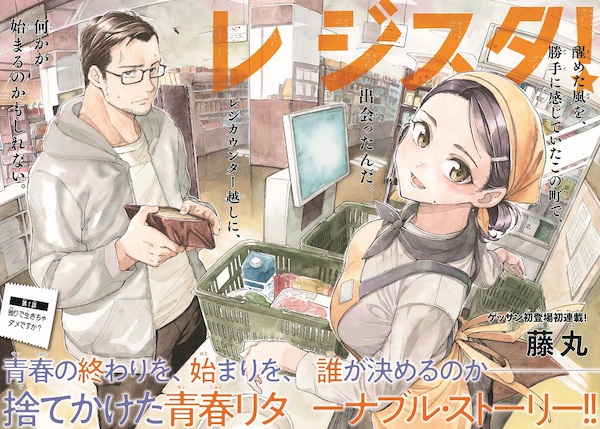
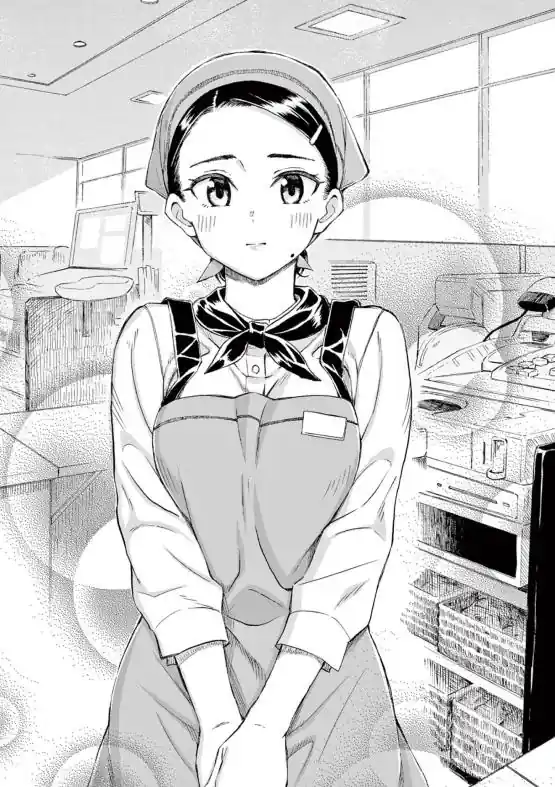
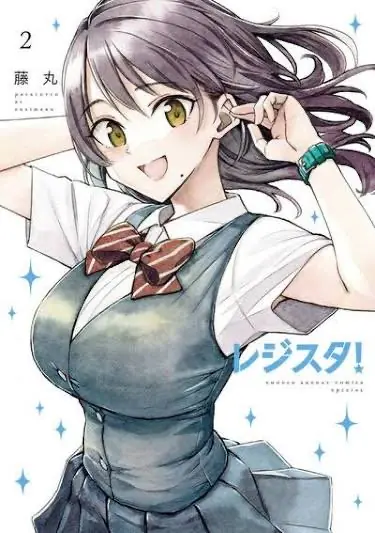
It all started when some women discovered the manga Register, written by Fujimaru. The manga is a romance about a 36-year-old man who goes to the store where he regularly shops and ends up falling in love with the cashier.
The cashier is a 16-year-old girl, and that’s where the story begins. I’ve only read the first one or two chapters, and nothing happens in those chapters. I have no idea whether the romance actually develops later on, but anyway, what followed was a massive controversy, with several women claiming the manga should be canceled, censored, and much more.
Based on my description, it might not sound like a big deal, but the controversy blew up so badly that otaku who simply wanted to enjoy their FICTION in peace got so fed up that they’ve now decided to fight back.
And they’re going after Yaoi/BL manga.
Readers and free speech advocates, fed up with what they see as a longstanding double standard when it comes to censorship, have launched an institutional counteroffensive: they’ve organized mass complaints to government agencies in an attempt to have BL works classified as “Harmful Publications” (Yuugai Tosho) and subjected to strict restrictions in Japanese bookstores.
The Spark: The Attempted Cancellation of ‘Register!’
The epicenter of the controversy was the manga Register!, published by Shogakukan in Gessan (Monthly Shonen Sunday). The series achieved considerable commercial success, surpassing 260,000 copies in circulation and securing third place in the prestigious Next Manga Awards (Tsugi ni Kuru Manga Taisho).
The story revolves around the relationship and romance between an ordinary 36-year-old man and a high school girl. That premise alone was enough to set Japanese social media on fire:
- Accounts on X launched a boycott campaign, accusing the manga of promoting grooming and romanticizing the exploitation of minors.
- Some mothers complained about the manga, saying they had become afraid to let their daughters work at convenience stores.
- Others claimed that the manga could give men the wrong ideas about women in real life, arguing that no cashier wants some old guy hitting on her.
- They also complained about the heroine’s appearance, particularly her being so young while having large breasts.
Outraged by what they saw as a one-sided attempt at cancellation, male readers decided to go after BL manga in return! They began mass-reporting BL titles and demanding censorship of works primarily aimed at female readers.
The Counteroffensive: Exposing Commercial BL Manga
While investigating the BL market, readers found stories containing far more explicit sexual content involving minors. They dug up commercially published works in which adults approach elementary school students (sixth-graders) while under the influence of alcohol, without ever having faced the same kind of public outrage or calls for prohibition.
They even discovered a YAOI manga that female readers apparently have no problem with. It’s called ぼくらの一線 and tells the story of a 22-year-old man who gets drunk and sleeps with a sixth-grade elementary school boy!
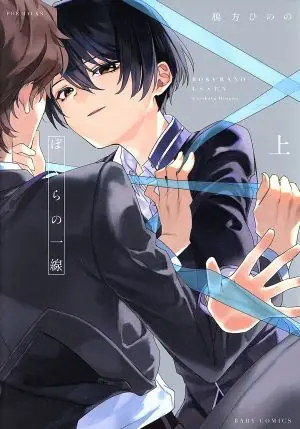
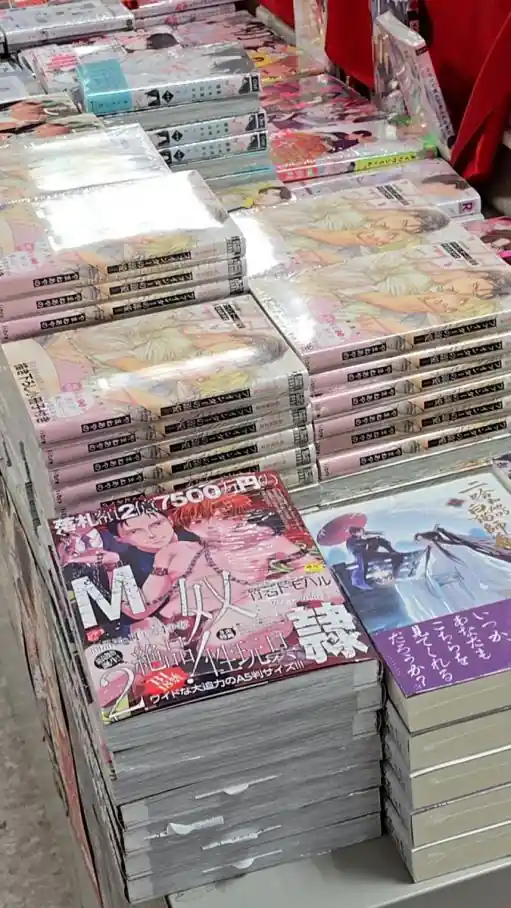
In addition, photographs of promotional book bands (obi) and bookstore displays were documented. Several volumes featured explicit anatomical terms and heavily sexual references printed directly on their covers, in plain view of anyone walking by.
I only gave ONE example here, but they found SO MANY BL manga with stories that are much more “problematic” than Register, okay? I even came across a chart listing several BL titles and the disturbing things featured in their stories. Many of them contain GRAPE SCENES…..
Faced with this situation, the online community moved beyond digital outrage and began organizing formal complaints.
Formal Complaints and the Creation of the ‘BL Fire’ Portal
Relying on the Youth Healthy Development Ordinance (Seishounen Kenzen Ikusei Jourei), users organized a systematic campaign of formal complaints:
User @hyknok cataloged five prominent titles from female-oriented rankings that contained material deemed inappropriate for minors. They also prepared formal documents listing each title’s name, author, publisher, ISBN code, pages containing explicit scenes, and an explanation of the alleged harm to young people’s development.
The BL Fire portal (bl-fire.com) was launched, bringing together official complaint channels for publishers, distributors, bookstore chains, public libraries, and credit card companies to centralize standardized complaints.
If a prefecture classifies these publications as “Harmful Publications,” the law requires them to be sealed in opaque plastic packaging and placed exclusively in sections restricted to customers aged 18 and older.
The Myth of Bookstore Segregation Comes Crashing Down
In case you didn’t know, manga in Japan is separated into different categories in bookstores. Hentai manga, for example, is placed in one area, while regular manga is displayed elsewhere. Adult manga aimed at men is always kept in a separate section, usually marked with an R18 sign.
Women began arguing that BL manga was already being displayed in the appropriate sections and that children couldn’t read or purchase these titles in bookstores. However, this turned out to be FALSE!
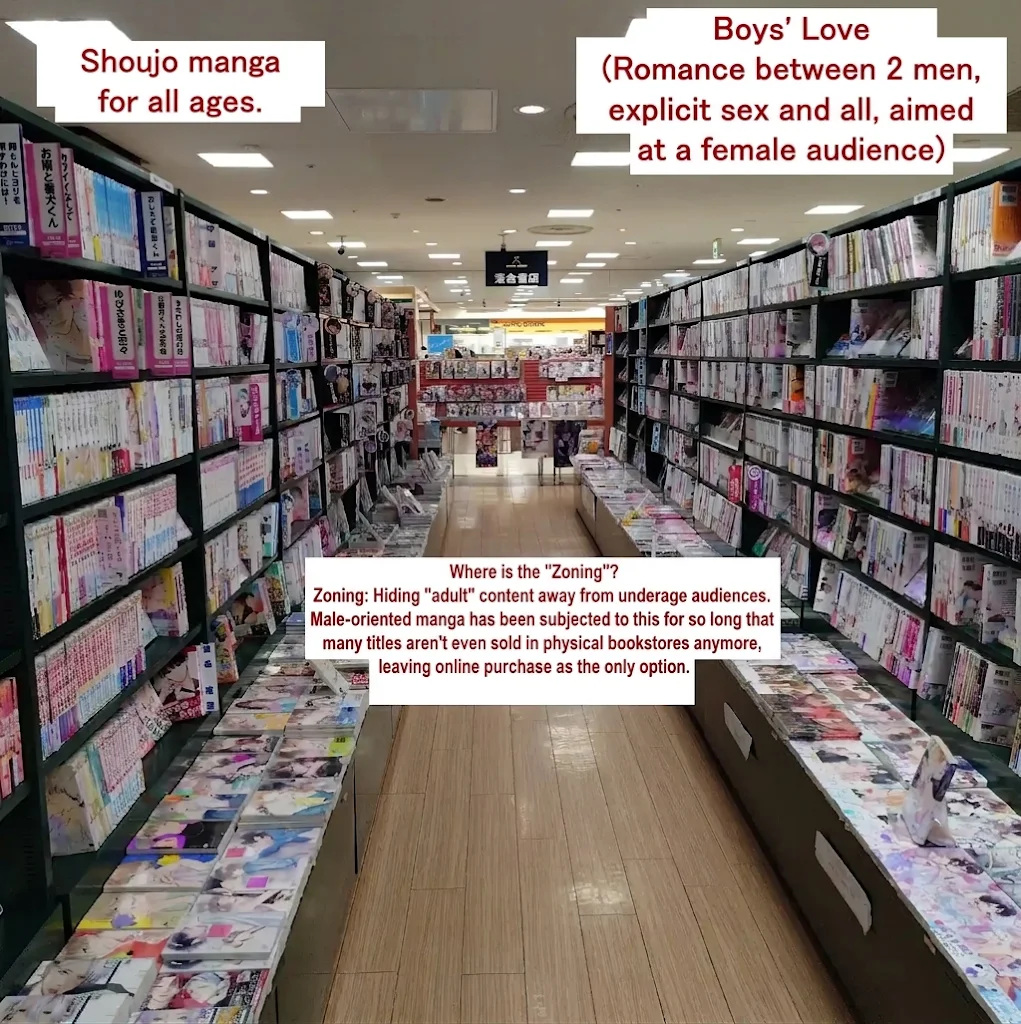
Internet users personally visited major retail chains, including the Ochiai bookstore at Utsunomiya Tonarie shopping mall, to document what the stores actually looked like:
Volumes containing explicit gay pornography and provocative covers were displayed on low shelves and in open aisles, right next to traditional shoujo manga and educational study materials.
Check out the photo below, taken by a Japanese visitor while inspecting a bookstore and translated by Seri3ma.
At other stores, entire shelves of adult-oriented books were positioned directly in front of children’s sections filled with illustrated picture books (ehon) and literacy workbooks for preschoolers.
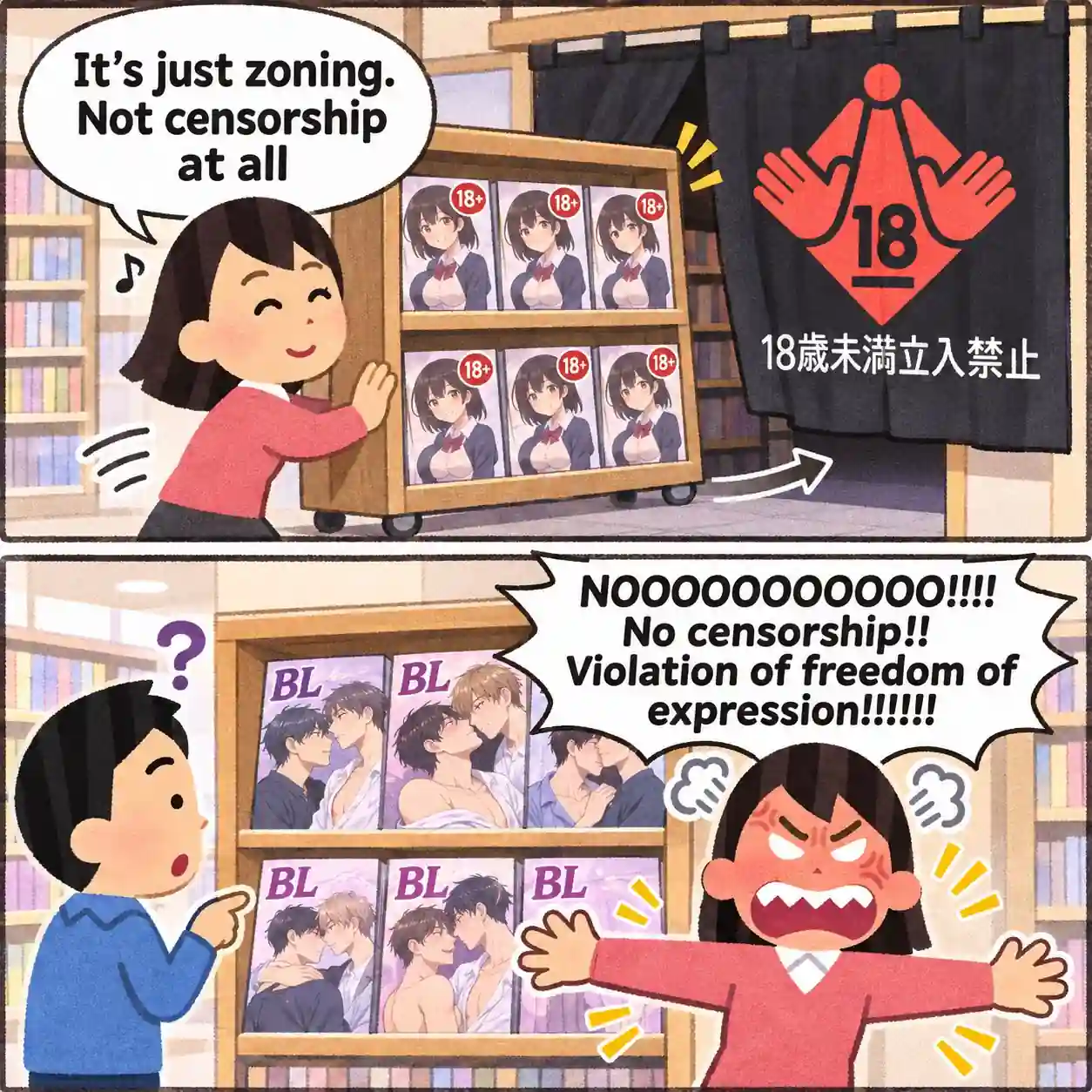
Unlike male-oriented adult manga — which is strictly hidden behind curtains (noren) or tucked away in isolated corners — female-oriented material continued to enjoy unrestricted access in regular bookstore sections.
People working in the book industry revealed the commercial and logistical reasons behind bookstores’ resistance to traditional genre segregation:
The taboo surrounding female consumers: Erotic content aimed at women experiences a sharp drop in sales when placed in sections restricted to customers aged 18 and older. To avoid making female customers feel embarrassed or guilty about their purchases, the market keeps these publications “available to all ages” HAHAHAHAHAHA!!!
Recurring thefts: Bookstore employees reported frequent losses of erotic manga aimed at women, allegedly stolen by young customers who were too embarrassed to take the books to the checkout counter. (IN OTHER WORDS, WOMEN ARE STEALING GAY BL MANGA!)
Unauthorized reading and damage: Some stores even put up signs asking customers to stop breaking the plastic seals on books to read them while standing in the store (tachiyomi), only to hide the opened copies in other sections. This damages the products and causes financial losses for both retailers and authors.
YES! This is actually happening. Check out the photo below:
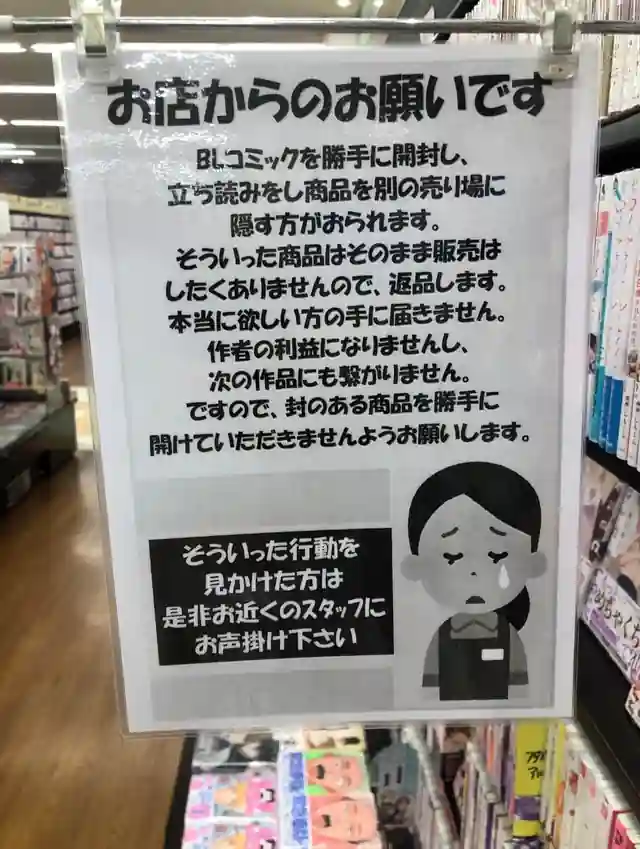
There are numerous reports of women going into bookstores, picking up a BL volume they really want to read, breaking the seal, reading the entire book, and then simply hiding it in another section so they won’t get caught. This causes losses for the store, which then has to return the manga to the publisher.
George Morikawa Breaks His Silence and Warns: “This Is Book Burning”
The escalating conflict caught the attention of one of the industry’s most respected figures: George Morikawa, creator of the classic boxing manga Hajime no Ippo.
In a detailed post on X, the author spoke out directly against the movement to file complaints with the government, warning about the devastating consequences of mutual censorship:
“Some men are asking: ‘What we enjoy has already been restricted, while BL is still allowed to circulate freely. Isn’t that unfair?’ I don’t see the issue that way. Today, the target is sexual expression, but if everything gets censored, the search for a ‘new injustice’ will begin immediately afterward: ‘What about violent scenes? Can those still be freely published? What about expressions considered discriminatory?’ The boundaries will become increasingly narrow, suffocating creators.
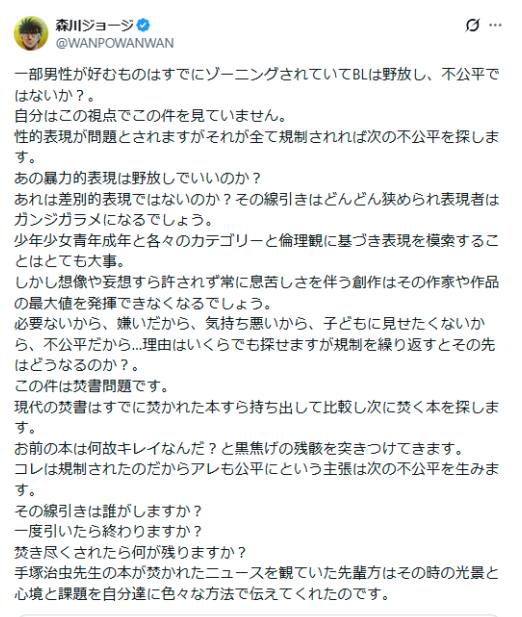
Creating under such restrictions, without even being able to use one’s imagination or indulge in fantasy, prevents a work from reaching its full potential. ‘We don’t need this,’ ‘I hate this,’ ‘It’s disgusting,’ ‘I don’t want children seeing this,’ ‘It’s unfair’… There will always be reasons to regulate something. But where does it end?
This has become a modern-day case of book burning. Today’s inquisitors are searching for books that were burned in the past and comparing them with those that haven’t been burned yet: ‘Why is your book still intact?’ they ask, pointing to charred remains. The argument that ‘if one work was restricted, another must be restricted too for the sake of fairness’ only creates more injustice. Who gets to draw that line? When everything has been burned to ashes, what will be left?”
Community Reactions: Hypocrisy or Mutual Self-Destruction?
Morikawa’s statement further intensified debates across forums like 5channel and social media:
Criticism of the author’s position: Several internet users pointed out that Morikawa had remained silent during the attacks against Register!, only speaking up once complaints began targeting works aimed at women. Others recalled the author’s past appearances on television debate panels, where he advocated for changes to the wording of youth protection laws after BL manga came under the spotlight of censorship campaigns.
The danger of scorched-earth tactics: Users from both sides warned that feeding the government’s complaint and censorship machinery is essentially an act of suicide for the entire otaku community. By legitimizing censorship committees targeting BL, readers of male-oriented manga, yuri, and ecchi are paving the way for their own favorite works to face even harsher restrictions in the future.
Cancellation fatigue: For many supporters of the complaint campaign, the scorched-earth approach has become the only possible response after years of selective cancellation campaigns targeting illustrations of large-breasted girls in shounen and seinen works.
The clash between demands for greater responsibility regarding the exposure of explicit material and the imminent danger of government censorship has placed Japan’s publishing industry at one of the most complicated crossroads in its recent history.
Now, let me give my opinion here: honestly, it’s about time! For YEARS, manga aimed at men have been the ones constantly facing controversies and complaints. It was about time someone went after the manga aimed at the people doing all the complaining.
Everyone could have simply minded their own business and enjoyed their FICTION in peace, but some people just can’t stop sticking their noses into other people’s interests.