
Woman Says Netorare Being So Popular Reveals More About Gender Discussions Than Twitter Fights

Netorare is extremely popular nowadays, so popular that many more manga and games based on the theme are being released. In fact, I recently made a post here where some Japanese people complained that netorare is already becoming oversaturated.
However, today I bring a new type of discussion involving netorare, this time made by a woman. She begins by saying that she was talking about netorare with a friend of hers, who is a hentai manga author, and they were discussing how a certain netorare manga ended up selling more than 1 million copies!
Then she started saying that a netorare manga selling more than 1 million copies reveals more about all gender discussions than any conversation you could see on Twitter about men and women.
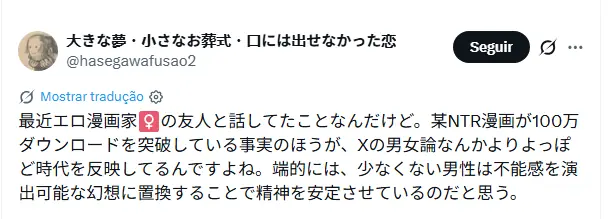
Get ready, because she talks about psychology and references Lacan here. I had a lot of trouble understanding what exactly she was trying to say.
According to her, many men have insecurities related to their own masculinity, especially the feeling that they are not enough for a woman, either sexually or emotionally.
Netorare would transform this fear into a controlled fantasy: instead of being only a source of pain or insecurity, a person can experience it inside a fictional story and feel pleasure from the situation.
She then uses Lacan to explain this idea.

In her view, many men carry the anxiety that they will never be able to completely satisfy a woman, because women are seen as something mysterious and impossible to fully understand.
In netorare, this anxiety is taken to the extreme: the fantasy is precisely imagining that there is another man who achieved something that he never could. The woman is having an extremely intense experience with someone outside of his control.
In other words, the person transforms a feeling of failure (“I am not enough”) into an erotic fantasy (“I feel pleasure precisely by imagining that I am not enough”).
After that, she compares this with a type of story that is popular among women: stories about broken engagements or “the abandoned woman who finds someone better” (and yes, you know this genre of manga/anime is EXTREMELY popular among women).

She says the difference is that, in these stories, there is usually an idea of revenge and overcoming adversity: the woman is rejected by a bad man and then finds a man considered “better,” more powerful, or more desirable.
In her view, this would be different from netorare because it does not involve the person finding pleasure in losing control or accepting their own powerlessness. The focus would be on regaining the value that was lost.
In real life, many crimes of passion and femicides are committed precisely by men who cannot deal with rejection, loss, or feelings of humiliation.
So she suggests that perhaps society needs to discuss more about how some people deal with their own feelings of powerlessness, rejection, and desire for control, instead of only talking about “respecting women.”

Her idea is that some fantasies can work as a way of processing destructive feelings within fiction, because a person can experience something painful in a safe environment.
She is not saying that every man who likes netorare is violent or has psychological problems. She is making a cultural/psychoanalytical analysis about why this type of fantasy can be attractive to some people. It is her interpretation, not a scientifically proven conclusion.
So, were you able to understand what she meant? If so, what do you think? By the way, she did not mention which netorare manga sold more than 1 million copies.