
Research Shows Over 70 Percent of Japanese Gacha Games Shut Down Before Their Third Year

The shutdown rate of Japanese gacha games has become a major topic among players after new data revealed how quickly most live-service titles disappear. According to recent research, more than 70 percent of Japanese gacha games shutdown before completing their third year of service, showing how unstable this market has become.
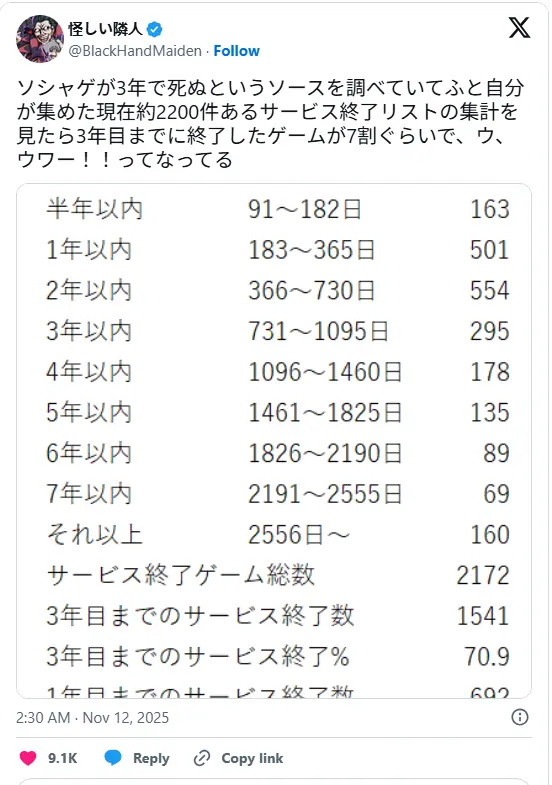
The japanese gacha games shutdown rate was highlighted by Ayashii Rinjin, a writer and researcher specializing in live-service titles. Using a database of nearly 2,200 games, they found that over 70 percent ended service before reaching their third year, and that most shutdowns happen in the second year of operation.

The research also shows how vulnerable these games are during their first year. More than 30 percent are discontinued before completing twelve months, either due to poor financial performance, lack of players, or internal production issues. Even projects backed by well-known studios have been failing to stay afloat.
Several recent cases illustrate this trend. Tribe Nine, developed by Akatsuki Games with supervision from creators involved in Danganronpa, will end services in less than a year. Other titles have collapsed even faster, such as the NFT-based TOKYO BEAST, which shut down only two months after launch due to widespread criticism and financial shortcomings.

The data reinforces the idea that managing a live-service game is a high-risk bet. More games shut down within their first six months than games that survive beyond six or seven years. Even when a title lasts for a decade, the weight of accumulated technical debt can make continued operation nearly impossible. This was the case with Dragon Quest of the Stars, which announced its end after facing complex technical challenges developed over ten years.
Meanwhile, the arrival of major titles from China has transformed market expectations. Genshin Impact set a new standard in gameplay and narrative depth, making many Japanese games feel outdated by comparison. Developers such as Hero Game, with Duet Night Abyss, and Naked Rain, with ANANTA, have even announced the removal of gacha systems entirely, suggesting major shifts ahead.
As production costs rise and competition increases, Japanese studios may need to rethink their approach to survive. Whether they will embrace new business models remains uncertain, but the shutdown rate exposed by recent data makes clear that the market is facing one of its most critical moments.