
The outrage of Japanese Animators over AI use and Cheap Outsourcing

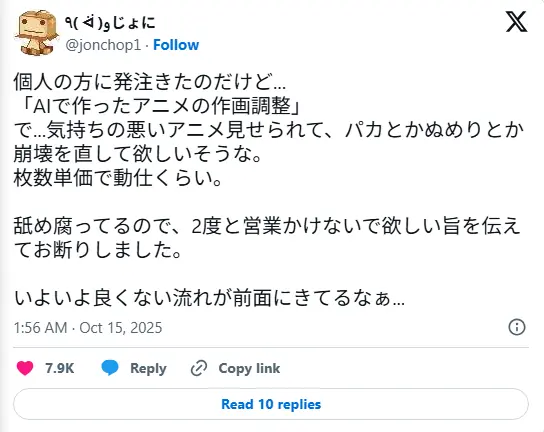
Japanese animators have shown growing concern about the impact that artificial intelligence and cheap outsourcing are having on the anime industry. One of these professionals, known as Joni, who has worked as an animator, character designer, and animation instructor, revealed on social media a job offer considered offensive to the profession.
According to Joni, he was contacted by an individual client to “fix” AI-generated animations for an extremely low price. The proposal involved adjusting issues like flickering, inconsistencies, and “broken” frames, with payment calculated per frame — almost the same rate as someone who only adds finishing touches to ready-made scenes.
“They’re completely out of their minds,” he wrote. “I told them never to contact me again. I feel like a dangerous trend is starting to emerge.”
The outrage of Japanese animators over AI use

Joni explained that he understands hiring animators can be expensive, but that it’s absurd to ask an experienced professional to revise AI-made animation for below-market pay. He believes that this type of offer comes from people who don’t understand how the industry works.
“I don’t want to be part of the idea that ‘having professionals fix AI-made animation’ allows for cheap commercial anime production. I’m not against combining AI technology and human labor, but paying less for it is wrong. The industry has already destroyed many animation directors because of this mindset.”
According to Joni, the problem goes beyond AI. Many Japanese animators report that the industry increasingly relies on cheap outsourcing to foreign studios. These companies deliver animation quickly and cheaply, often with poor quality, which then has to be revised by animation directors in Japan.
However, these directors receive fixed pay per episode, even when the correction work is extensive. This creates enormous pressure on professionals, leading many to quit due to exhaustion and lack of recognition.

The animator emphasized that this practice has contributed to the disappearance of experienced directors and weakened the overall quality of Japanese productions. He warned that the use of AI to replace human labor, combined with low-cost outsourcing, could worsen the crisis even further.
In his message, Joni also made a direct appeal to other animators to be careful when accepting similar offers. He warned that very cheap proposals, disguised as “tests” or “simple jobs,” only help normalize underpayment and devalue artistic work.
“Avoid taking on jobs that promise to be just a ‘cheap test’ or a ‘partial fix.’ These offers only reinforce the idea that AI-made animation can replace human talent at low cost,” he said.